

Overview
When you're dealing with property damage, you'll hear both "restoration" and "reconstruction" — sometimes used interchangeably, which causes confusion about what you actually need and who does what. They're related but distinct phases. Here's the difference in plain terms.
Restoration: stabilize, clean, and return to pre-loss condition
Restoration (also called mitigation and restoration) is the work of stopping the damage and returning your property to the condition it was in before the loss — without major rebuilding. It includes:
The goal is to save and restore as much of the existing structure and contents as possible. This is the core of what a restoration company does, and it's covered on our process page.
- Mitigation — stopping the spread (water extraction, board-up, containment).
- Drying the structure (for water/fire-water).
- Cleaning and sanitizing — soot removal, mold removal, disinfection.
- Deodorizing and minor repairs.
Reconstruction: rebuild what can't be saved
Reconstruction is the rebuilding phase — replacing or reconstructing the parts of the property that were destroyed or can't be restored. It includes:
Reconstruction is essentially construction work to put the building back together after the damage was too severe to simply restore.
- Rebuilding structural elements (framing, drywall, subfloors).
- Replacing flooring, cabinetry, fixtures.
- Finishing work — painting, trim, final touches.
How they fit together
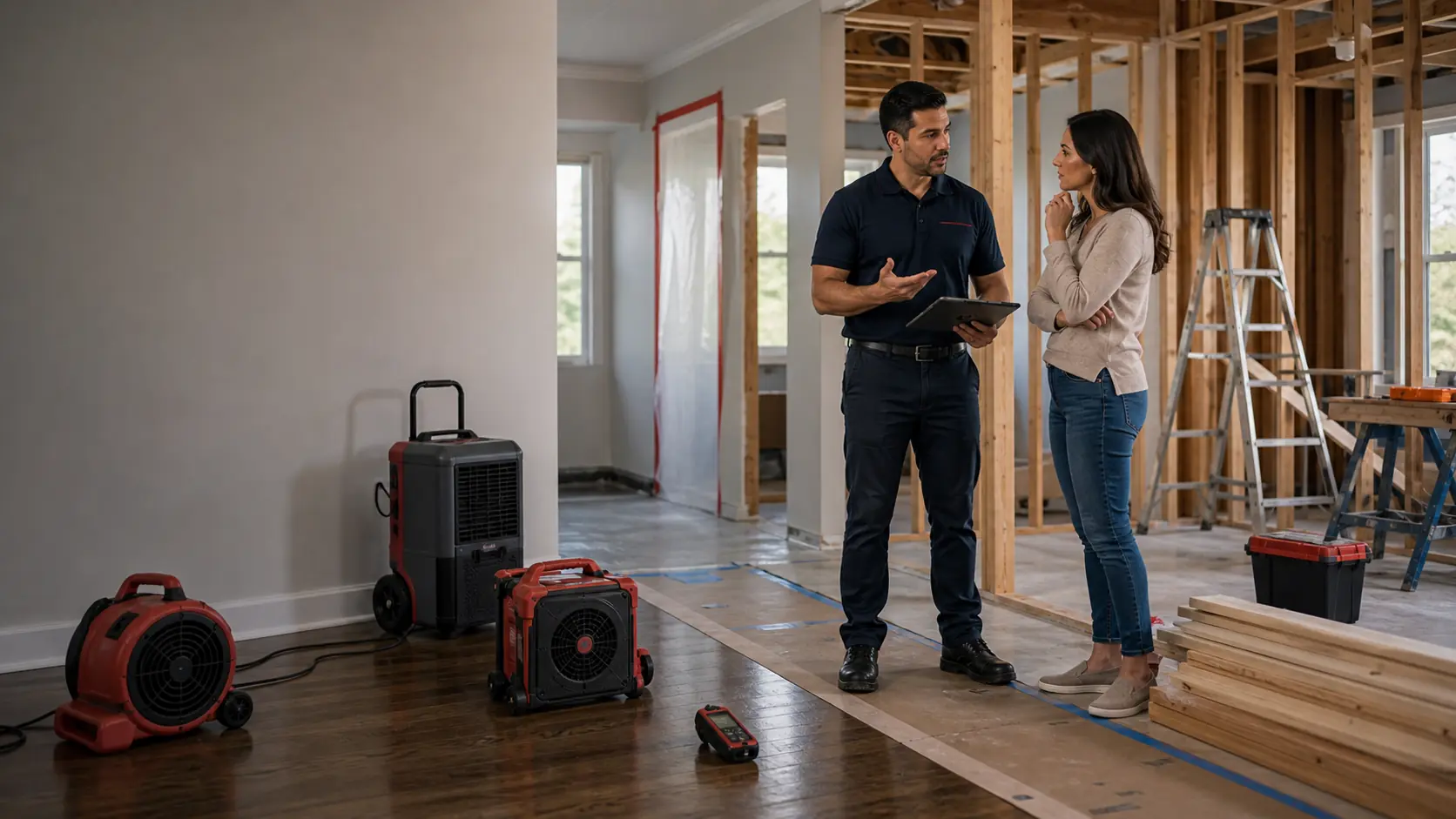
For minor damage, restoration alone may be enough — fast drying saves the materials, and little or no rebuilding is needed. For major damage (a serious fire, extensive flooding), the job flows from mitigation → restoration → reconstruction: stop and stabilize, restore what's salvageable, then rebuild what's lost. The faster and better the early restoration, the less reconstruction is needed — which is one more reason rapid response saves money.
Who does what
Some companies handle mitigation/restoration only; others handle the full path including reconstruction; and some coordinate licensed trades for the rebuild portion. When hiring, it's fair to ask which scope a company covers so you know whether you'll need additional contractors. (See how to choose a restoration company.)
The takeaway
Restoration saves and returns your property to pre-loss condition; reconstruction rebuilds what couldn't be saved. Minor losses may need only the former; major ones need both, in sequence. Understanding the distinction helps you ask the right questions and plan the full recovery.